

Medical-Enterprise Collaboration Leads a New Chapter in Precision Medicine
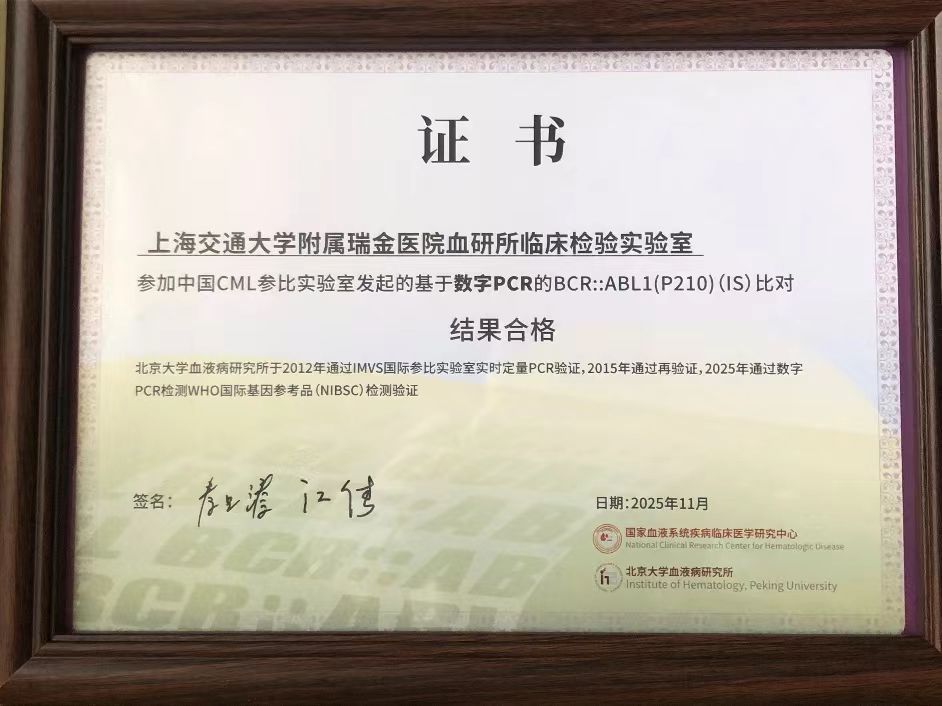
Recently, two BCR::ABL1 quantitative detection methods (RT-qPCR and digital PCR) from the Clinical Laboratory of the Hematology Institute at Ruijin Hospital, affiliated with Shanghai Jiao Tong University School of Medicine, successfully passed international standardization validation. Among them, the BCR::ABL (p210) quantitative detection kit developed jointly by Ruijin Hospital and Dunwill Medical based on Roche Diagnostics' digital PCR platform performed outstandingly. Its test results can directly output internationally standardized percentages (IS%) and MR grades (MR3.0–MR5.0), enabling precise comparison with detection data from different laboratories worldwide and international treatment guideline target values, demonstrating solid technical capabilities and high-quality testing standards.
Chronic myeloid leukemia (CML) is a malignant clonal disease originating from bone marrow hematopoietic stem cells. Its treatment goals have shifted from merely pursuing disease remission and survival extension to higher quality long-term survival, reducing adverse reactions, and achieving treatment-free remission (TFR). Long-term deep molecular responses (DMR) in patients are essential prerequisites for achieving TFR. The level of BCR::ABL1 (p210) transcripts is key to evaluating post-treatment molecular responses in patients, and accurate and stable molecular testing holds significant reference value for CML patient treatment.
Differences among laboratories in testing methods, reagents, and instruments may lead to deviations in test results for the same patient sample across different institutions, affecting disease assessment and treatment continuity. Promoting international standardization of CML molecular testing is a crucial initiative to achieve result recognition across institutions and regions and improve diagnostic and therapeutic homogenization. Furthermore, with the advancement of CML treatment goals, sensitivity requirements for detecting BCR::ABL1 (p210) have increased from MR4.0 (BCR::ABL1IS ≤ 0.01%) to MR4.5 (BCR::ABL1IS ≤ 0.0032%) and even MR5.0 (BCR::ABL1IS ≤ 0.001%). Standardized validation of test results at MR4.5 and above has become particularly critical.

The '2025 Precision Guardian: PCR Testing Standardization Enhancement Project for Chronic Myeloid Leukemia,' initiated by the Beijing Renze Public Welfare Foundation and jointly led by Professors Jiang Qian and Qin Yazhen from Peking University People's Hospital, was launched. The project brings together 60 clinical laboratories and third-party testing institutions nationwide. Through systematic research and laboratory comparisons, it aims to comprehensively understand the current testing landscape, explore pathways for standardization enhancement, and pave a more sensitive and precise path for efficacy monitoring for CML patients.
The BCR::ABL1 (p210) quantitative detection kit co-developed by Ruijin Hospital and Dunwill Medical achieves a sensitivity level up to MR5.0, providing clinicians with an advanced molecular diagnostic tool. Compared to traditional RT-qPCR methods that suffer from insufficient sensitivity and reliance on standard curves and correction factors when detecting low-level transcripts, this kit represents a technological breakthrough based on digital PCR technology. It supports direct output of internationally standardized percentages (IS%) and MR grades (MR3.0–MR5.0) without requiring calibration, eliminating cross-platform deviations at the source. Combined with the high-throughput and low-error advantages of the Roche Diagnostics digital PCR platform, this kit demonstrates excellent reproducibility and inter-laboratory consistency while maintaining high sensitivity, significantly enhancing testing convenience and result reliability. It is expected to be widely applied in medical institutions at all levels, facilitating rapid advancement in the standardization process of CML molecular testing.
With profound technical expertise in original biomarker transformation and multi-platform integration advantages, Dunwill Medical adheres to a clinical needs-oriented approach. Relying on an innovative collaborative model of 'clinician-led R&D with enterprise-assured production and quality control,' the company efficiently promotes the transformation of laboratory achievements into clinical applications. The successful launch of this BCR::ABL1 quantitative detection kit once again demonstrates Dunwill Medical's strong R&D capabilities and industrial implementation capacity throughout the entire 'medical-research-industry' chain, providing a solid tool for precise diagnosis and treatment of hematological diseases.
In the future, Dunwill Medical will continue to deepen collaborations with clinical institutions and accelerate the transformation of innovative technologies into clinical applications. The company aims to provide more medical institutions and patients with precise, reliable, and cutting-edge testing services, supporting individualized CML treatment and long-term disease management, contributing to the overall improvement of China's hematology diagnosis and treatment standards.